This Sisyphean
work nears its end. As is so often the
case with life and art, conversation and literature, consciousness and culture,
what remains unsaid, that which still begs for development, and that which
tantalizes with its only half-visible outlines appears at least as compelling
as that which has taken solid, tangible form.
In a sense, finishing, for all its vaunted supremacy, is overrated.
Nowhere might such a conclusion
resonate more powerfully than it does in regard to JMW Turner. Just as some of his most poignant and
awe-inspiring works come to us as only partial expressions of a final
product,
so too the facets of his life seem to expand into unfathomable depths, which no
amount of investigation or study will ever fully recount. One might make a strong case for this view or
that perspective, but the actual man—replete at once with limitless subtlety
and perversely stubborn routines—may slip each harness that the annalist tries
to attach. Gordon Parks
biographical novel is just one fine example of that.
Contradictions and Non Conformism
In a sense, the challenge of
Turner’s oeuvre looks the same from his perspective as it does from that of the
present-day observer. Making sense of
contradictions as puzzling as Heisenberg’s or Fermat’s mathematics, one can
only take a stand and persist in its defense, much as Turner had to do again
and again with critics who lambasted him for his style, his cheek, his
recalcitrant insistence, in confrontive and dismissive fashion, on
non-conformity and breaking altogether
new ground.
This blog, as I and my spousal
support unit both intuited from the start, has also plowed into polarized
possibilities that seem impossible to rectify.
Thus, dear J.M.W. renders masterfully yet becomes inured of immersing
himself in
abstraction;
he avoids family entanglement and yet sets himself up as Admiral Booth or Mr.
Danby—attaching himself to a
mistress’ name as well as her flesh—as the fancy strikes
him;
he seems to avoid people in close up and yet both the common folk and legendary exemplars repeatedly walk in
miniature through his canvases; he presents women as dolls or children and yet
has an entire trove of steamy
erotica, collected at first hand as he
observed not only his own paramours, but also sailors and their lovers and
concubines and prostitutes, all recklessly abandoned to the throes of passion.
And today, we see that this utter
master of the British isles, of the imperial firmament and the English soils
that have gone down to the sea in ships, had a lifelong predilection to travel,
to engage the mythic past, to search for universal meaning abroad. Nowhere drew Turner’s attention, at least
arguably so, more powerfully than did the light and luster of
Italy.
Idyls in Italy
 |
| Italian Landscape - EPP Version |
Likely countless potential
explanations for this attraction are plausible, and for the vast productivity
that resulted from it in Turner’s efforts.
On his first extensive trek beyond the Alps, he produced hundreds and
hundreds of
sketches,
including of a
coach accident that might have killed him,
which he rendered as he sat on a snow bank, while his fellow travelers discoursed
about their narrow escape. Had he been around today one might imagine him sitting atop a building in the 8th ward of New Orleans sketching and documenting Katrina's devastation in 2005.
However, probably variations on two
themes have become most popular. In one
of these, characterized most aptly by
Simon Schama,
Turner’s choices and actions flow from his desire to perfect his craft, from
his complicated and never-completely-formulated ideas about life and death and
England and the cosmos, and from a certain proclivity to play the gadfly
regardless of the consequences with his critics
Of course, these estimates do not
rule out radical inclinations. As Schama
notes,
“hard times, radical times… .(led to) Turner’s refusal to beat the patriotic
drum or wave the flag, (which) cost him patrons,” but he celebrated the common
people instead. He “rubbed shoulders
with the desperate and the destitute.” Moreover, he resisted “an empire of solid
prosaic commercial facts…wanted more, insisting on …poetic imagination.”
But not any practical dedication to
resistance or reform, but a “tragic sense powers and frames his works,” so that
not anti-imperialism but “cosmic reckoning” guides the world: of Alps’ snows
that led to Hannibal’s demise in one of Turner’s first ‘Italian canvases;’ of
fate’s whim that caused, in an earlier painting of a later battle, a “carpet of
corpses at Waterloo…an apparition of pure hell.”
The Charms of Venice
In this view, Turner was merely
Romantic, filled with vague longings and a wish to find technical mastery that
demonstrated classical beauty. Venice
permitted this, says Schama. “For 20
years off and on, Turner made the city his soul mate.” He depicted “the gauzy radiance of the place…
. conjured from a daub here, a wisp there.”
Gerald Finley’s
Angel in the Sun: Turner’s Vision of History
also holds such a
viewpoint. “In (his) later Venetian views, as in his
1819 watercolors, Turner portrays Venice as a city bathed in light, colour, and
insight. Its transmutation of either
colour into form or form into colour is an implicit denial of the traditional
distinction between
disegno and
colore.”
Finley admits Turner’s attachment
to Byron, snippets of whose verses decorated many of his panoramas of
Venice. But the scholar only sees that
the poet and the painter “refer(red) to the appearance of Venice and the
significance of that appearance.”
Empire, resistance to oppression, and radical uprising factor only more
marginally into the equation.
Sam Smiles is another academic who
manifests these idealistic notions in his
writings. At the same time, Smiles makes clear that a
significantly different view, perhaps even opposite, that in fact Turner’s art readily
and regularly expressed a deeply radical and conscious resistance to what
Schama called ‘the patriotic drumbeat,’ is also fairly common among
investigators.
In this second perspective,
Turner’s four visits to Central Italy merit at least as much attention as his
three sojourns to Venice. Furthermore,
observers need to examine all of this traipsing about the continent in the
wider context of Turner’s entire body of work, and with an understanding of the
historical and social background from which his labors emerged.
A reviewer of the January show at
the National Gallery of Scotland stated this point explicitly. “’When
people think about Turner and Italy, they tend to think about Venice, and quite
rightly, because his Venetian works were wonderful,’ says Christopher Baker,
deputy director of the National Gallery of Scotland and show organiser. ‘But it's only part of the story. It's really Rome that dominated his oil paintings
from 1819 to the 1830s. Also, you need
to look at the whole process, from when he's dreaming about Italy in the 1790s
up to his final visits when he's a grand old man in the 1840s.’”
Looking at the Future Through the Lens of the Past
And what does such an approach
yield? According to Baker, one can infer
that Turner’s purpose is nothing less than an interconnection of mythic and
historical themes into critiques of contemporary Victorian life. In addition, Turner intends to turn
classicist art upside down, so that even his vaunted use of color and light
serves a rebellious, albeit an aesthetic, objective.
An art critic’s
journalistic take
on the show considers the four decades of Turner’s weaving of Italy into his
travels and his craft. His ‘purely formal’
mastery at the new century’s beginning contrasts markedly with an agenda later
noteworthy for its ambitions: to integrate past and present through the
‘palette’ of Italy’s magical resplendence in English consciousness, using
classic images and mythological themes to highlight his fellow countrymen’s
present-day problems and prospects.
James Hamilton’s in many ways
definitive biography,
Turner, accedes
as much. Not only does Turner generally align with the
radically democratic Walter Fawkes, creating the ‘Fairfaxiana watercolors’ to
champion deepening England’s populist potential, but he also extends such
conceptions to his grappling in his art with Italy and travel generally.
A recent course at Arcadia
University, one of England’s bastions for peering into British history with a
global lens, also makes such a point plainly. Combining Dickensian literature with
Victorian culture generally, including Turner, the
class “approach(es) London
from a number of different perspectives: disease, crime, poverty, intoxication,
empire, race, sexual deviancy, capitalist greed and radical politics.”
Leo Costello’s masterful J.M.W. Turner and the Subject of History
extends this general point about Turner’s radical views and his choice of
subject and execution to Venice itself. In
his chapter, “’In Venice Now:’ History, Nature, and the Body of
the Subject, “Costello mandates that his readers dig below a surface
celebration or a facile critique.
He uses Turner output such as “The
Bridge of Sighs,” the artist’s first oil
from his visits to
Venice. That
conveyance had a well-known, or at least widely presumed to be accurate, past,
which was to move political prisoners to the cells where their lives would end.
Costello imputes a insurgent, even a revolutionary, goal to Turner’s choices of
subject, depiction, and execution in such instances.
“For Turner, as the example above
suggests, Venice became a site for exploring linked questions of artistic and
historical subjectivity. In particular,
I will show that he was interested in the physical, sensual relationship of the
artist to the external world. That
relationship produced a very different kind of pictorial subject than the model
of history painting that Turner had inherited, one that is essentially private,
specific, and embodied, where the traditional subject of history painting had
been public, ideal, and physically absent.”
The annalist from Rice University creates a highly
sophisticated and deeply layered
rubric for considering these questions of
society and its individual agents, the former expressing cultural reality that
both stems from and profoundly influences individual agents and networks of
agents. While such nuanced presentations deserve the
closest study and the most rigorous explication, for our humble requisites, we
might only put forward a quotation from Jeremy Bentham that Costello
employs.
The teacher from Texas deploys the thinker to imply
interconnections between the one and the many, and conflicts between the masses
and the few, that called out to Turner on a daily basis and that call out to us
across nearly two hundred years. Bentham,
and Turner, in sharp contrast to Thackeray and his clever ilk, demands that we
notice “’the sacrifice made…of the interest
and comfort of the subject-many, to the overgrown felicity of the ruling
few…’”
Towards a Dialectical History Painting
Professor Costello expands this
contention still further
in an essay in a
monograph,
Changing
Perspectives on Post-Revolutionary Art. Costello entitles his narrative suggestively:
“History in Decline? JMW Turner and His
Conception of ‘a swamp’d world.’”

He writes: “ This paper…
consider(s) the methodological stakes of an investigation of representations of
decline, disintegration, and destruction. …This paper considers these urgent
questions by examining J.M.W. Turner as a highly suggestive case study of the
ways in which a socially-informed history of art can be sensitive to
complexities and contradictions in the production of historical narratives,
both then and now. In 1802 Turner
criticised Nicolas Poussin’s
Deluge… . “The lines are defective as
to the conception of a swamp’d world and the fountains of the deep being broken
up,” he wrote. This paper considers
Turner’s abiding interest in giving form to the process of disintegration,
placing it within the linked discourses of aesthetic theory, imperial decline,
and nation building in post-revolutionary Britain.
Yet another instance of this occurs in the
compendium,
Discourses of Slavery & Abolition,
in which Costello’s essay, “Turner’s ‘The Slave Ship:’ Towards a Dialectical
History Painting,” appears. Costello
dissects the canvas with a meticulous attention to detail, a methodology as
necessary as it is arduous if the desired outcome is something other than
fatuous self-congratulation or surface worship of the pretty.
“Calling into question the linear progression
of time and civilization, Turner’s painting prompts a reading which considers
the interplay of past and present and places the burden of interpretation on
the viewer, whose own time is implicated.
Painting in 1840, Turner refused to locate British involvement in
slavery and the slave trade purely in the past, showing instead how it
persisted even in the wake of the 1807 Abolition of the Slave Trade Act. Furthermore, this non-linear temporal model
resists presenting an optimistic vision of the future. As a result, I will refer to The Slave
Ship as a dialectical history painting, as its conception of historical
change is based in this constant negotiation of past and present.”
 |
| Sun of Venice Going to Sea - EPP Version |
|
One may readily apply such thinking to suggestive but
not fully articulated notes from the
Tate about Turner’s relationship with Venice.
“The Sun of Venice Going to Sea” is much more than a ‘pretty
picture.’ The poetry that Turner
attached proves this.
“Fair Shines the morn, and soft the zephyrs
blow,
Venezia's fisher spreads his painted
sail so gay,
Nor heeds the demon that in grim repose
Expects his
evening prey.”
While the yeomen of the Tate do not mention any attack on
imperialism, one might, a la Costello, ‘put two and two together’ as it were.
Beyond Mere Pretty Pictures
Such
careful interpretation does more than make art more meaningful. It surpasses the addition of imaginative
value to the process. It is also loads
more fun. Relevance, creativity, and
enjoyment are enough rationale to slog along this pathway some more. Perhaps a follow-up, looking at Turner’s
utilization of and presence in fiction poetry, will attempt such additional
discussion. A finishing touch on today’s
discourse turns to a youthful interpreter of beauty and society.
A young undergraduate takes the
insistently ‘progressive’ contemplation of Turner to a totally Marxist
conclusion. He points out, that Turner finds the “
cost of empire (is)too great to bear.” Further, he notes that the artist has clear
political beliefs congruent with the view that “
repressive ideologies prevent us from understanding the material and
historical conditions in which we live because they refuse to acknowledge that
ideology matters,” if for no other reason than that without ideology
‘rallying one’s allies’ is impossible.
Turner, he says, has a commitment to such a rallying round.
His extensive thinking on these
matters goes still
further. Turner, he argues, wanted the British to look
at themselves, to ‘examine their own consciences,’ in the Catholic idiom. Most important, he wanted to influence action
that might contribute to human survival.
His paintings would “
point out
the brink of the frightful precipice…(that attended)imperial might.” In his choice of verse and view and theme, he
“
warn(ed) against the trappings of
imperialism” as a fatal path for England to follow.
A student of such issues as these
might spend many lifetimes sifting and parsing the evidence and what others
have made of this trove of data from the past, itself a tiny and insignificant
fraction of all the facts and eventualities that actually transpired. Why do such considerations matter?
Should we care that Thackeray, who
extolled empire in
Vanity Fair and
elsewhere, sardonic pen notwithstanding, detested Turner’s “Slave Ship?” What can we make of Ruskin’s declaring it—for
all of his prudishness, he was a thoroughgoing Dickensian radical—
iconic?
While I’ve been too ready to follow
the side track and risk derailing my artistic endeavors, I nonetheless contend
that such questions are important. And,
whatever the multitude of options for responding to these queries, this much is
clear for me: a truly radical, dissenting, and even social democratic reading
of Turner’s life and enterprises is, if not utterly dispositive, well beyond
highly plausible.
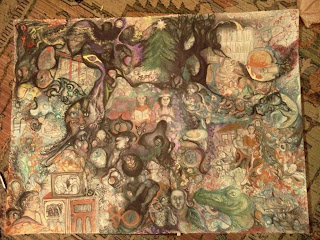

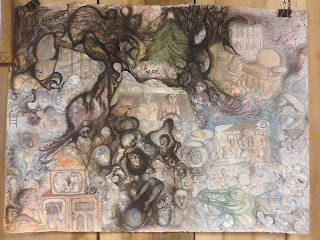


 In addition, we sell photography, and some of my oil paintings as well. The effort involves setting up 3 to 4 times a week in venues in Asheville and Hot Springs. The rest of the time goes into actually producing the art!! The above piece took over three days to produce, from start to finish. Multiply that by the approximately 90 pieces that we have on display at all times, and folks can see how much of my time and Jim's is spent in production mode! So... half the week producing wood pieces, half the week setting up to sell --- I hope folks can come to undestand how easy it is to fall off the radar. If anyone were interested in reading/experiencing more about this artistic modality, one can go to our facebook page, or to marshallcommunityarts.com (also not updated in a long time, oh dear!) You can also send me a message and I can add you to our mailing list - once a season I send a communique.
 But any time anyone comes visit us, we are more than happy to show them the fruits of my labour! After about the 50th one, people begin to cry uncle! There's only so much art one can take all at once, but in the end, even though I have yet to find a proper venue, I am satisfied in viewing the wonderful work and I recall how it was--- one of the most memorable and enjoyable chapters of my life. So... to everyone, thanks so much as always, and I do hope to hear from everybody at some point.